
Power Banks in Pakistan: mAh, Type-C and Why Your Phone Dies Early
What mAh means and how to size one for your phone What mAh means and how to size one for your phone Every power bank in Pakistan is sold with a number on the box: 10000mAh, 20000mAh, and so on. Most buyers assume a bigger number means more charges. That is only half true. Here is what mAh actuall
Is guide me se products
Nyvoxa ke actual products — COD, 7-day return aur warranty ke sath.
What mAh means and how to size one for your phone
What mAh means and how to size one for your phone
Every power bank in Pakistan is sold with a number on the box: 10000mAh, 20000mAh, and so on. Most buyers assume a bigger number means more charges. That is only half true. Here is what mAh actually means, and how to pick a size that matches your phone instead of guessing.
mAh is just a measure of stored charge
mAh stands for milliampere-hour. It tells you how much charge the battery inside the power bank can hold. A 10000mAh bank holds roughly twice the charge of a 5000mAh bank. Simple enough.
The confusion starts because your phone's battery is also rated in mAh, but the two numbers do not match up one to one. A typical phone in Pakistan today has a battery between 4500mAh and 5000mAh. So a 10000mAh power bank should give you two full charges, right? In practice, you get closer to one and a half.
Why you never get the full number
Two things eat into the capacity:
- Conversion loss. The power bank stores energy at about 3.7 volts and sends it out at 5 volts or higher. That step loses roughly 15 to 25 percent as heat. A 10000mAh bank delivers something closer to 7500 to 8000mAh of usable charge.
- Charging loss. Your phone also loses a little while charging. Add another 10 percent or so.
A rough rule that works in real life: take the power bank's mAh, cut it by about a third, then divide by your phone's battery size. That gives you the number of full charges.
- 10000mAh bank, 5000mAh phone: about 1.3 to 1.5 charges
- 20000mAh bank, 5000mAh phone: about 2.5 to 3 charges
- 1500mAh bank, 5000mAh phone: about 20 to 25 percent of one charge
Why a small bank can still fill a big phone
This is the part people miss. A power bank does not have to fully charge your phone to be useful. If your phone is at 8 percent and you are stuck in traffic on Shahrah-e-Faisal with no charger, getting to 30 percent is the difference between calling a ride and walking. A small bank is not competing with a 20000mAh brick. It is competing with a dead phone.
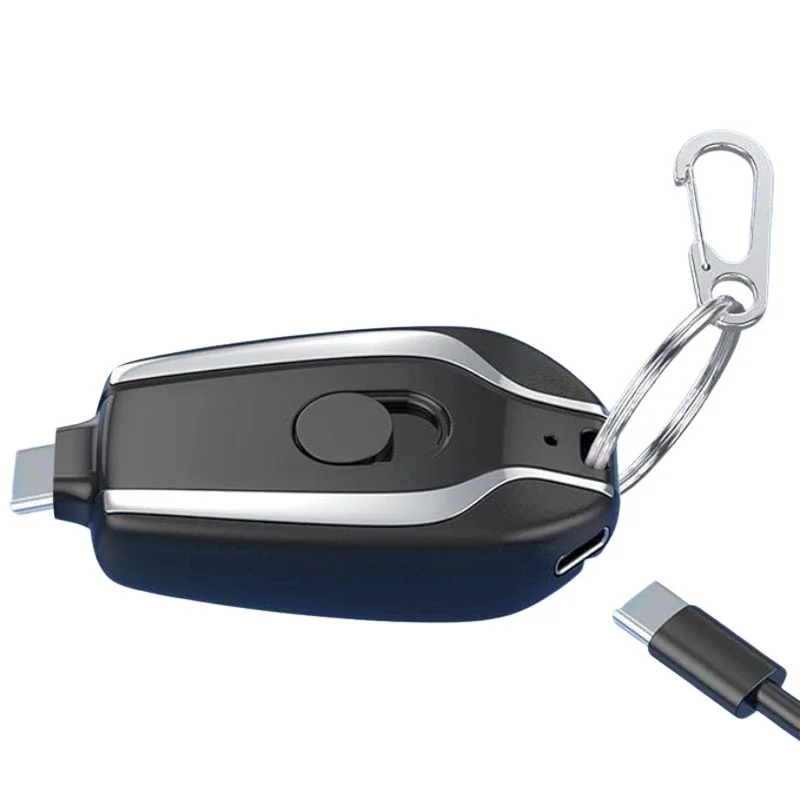
That is the whole point of the Mini Keychain Power Bank 1500mAh at Rs 1,099, reduced from Rs 1,500. It is not a replacement for a full-size bank. It is the one that lives on your keys, so it is actually with you when your phone dies. Type-C fast charging, works with iPhone and Android, and small enough that you forget it is in your pocket.
Who should buy which size
- 1500mAh to 5000mAh: for emergencies and light top-ups. Best for people who are rarely far from a wall socket but want a safety net. The Mini Keychain at Rs 1,099 fits here.
- 10000mAh: the sensible default for most people. One solid charge, still pocketable.
- 20000mAh and above: for travel, load-shedding days, or if you carry two devices. Heavier, and you will notice it in your bag.
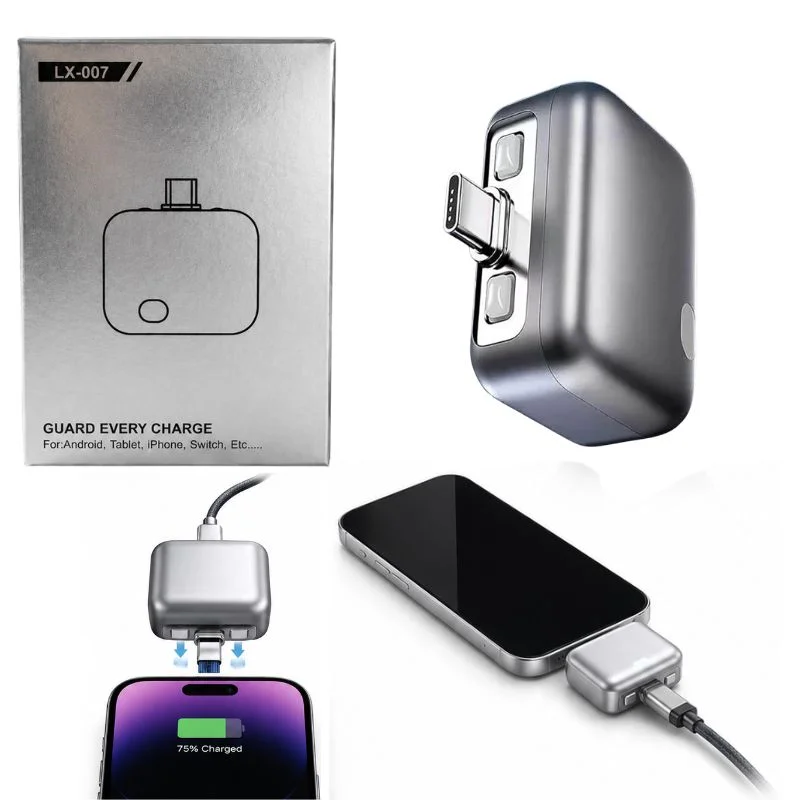
One more thing worth knowing: leaving a power bank plugged in after your phone is full is hard on the battery. If you do that often, the LX-007 Automatic Charging Disconnector at Rs 1,799 cuts the power automatically at 140W, which protects both your phone and the bank. It is a small add-on, but it saves you from replacing gear early.
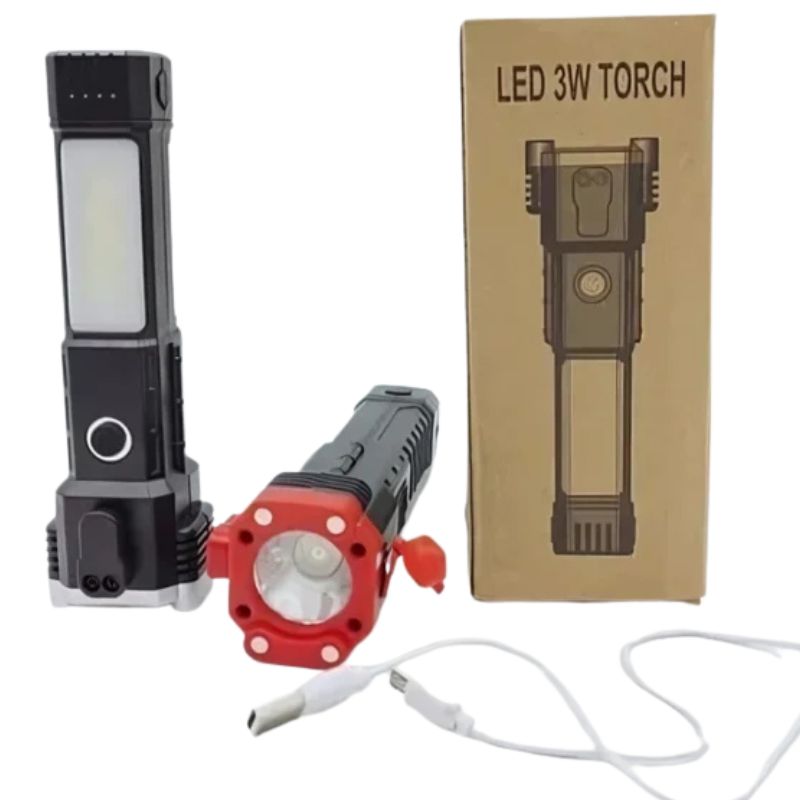
And if you want a backup that does more than charge, the Tactical LED Flashlight with Power Bank & Safety Hammer at Rs 799 covers light, a power bank, and a window breaker in one item. Reasonable for a car or a kitchen drawer.
Cash on Delivery is available across Pakistan. Delivery takes 2 to 4 working days in Karachi, Lahore, Islamabad, Faisalabad and Multan, and 3 to 5 working days elsewhere.
Charging speed, ports and the damage question
Charging speed, ports and the damage question
Most people buying a power bank in Pakistan look at one number: mAh. That is understandable, but it is not the number that decides whether your phone charges quickly, or whether your phone stays healthy after six months of daily charging. The port type and the protection circuitry matter just as much, and they are where cheap power banks quietly cut corners.
Type-C versus micro USB
Type-C is now the standard on almost every Android phone sold in Pakistan, and on iPhones from the 15 series onward. Micro USB still shows up on older phones, small gadgets and budget accessories. The practical difference for a power bank is simple:
- Type-C on both ends means you can charge the power bank and your phone with the same cable. One cable in your bag, not two.
- Micro USB input on a power bank means you must carry a separate cable just to recharge the bank itself. It also charges the bank more slowly.
- Output ports matter more than input. A bank with two outputs lets you charge a phone and earbuds together without splitting the speed.
If your phone is Type-C, buy a Type-C power bank. Carrying a micro USB cable in 2025 for a device you use daily is a small annoyance that adds up.
Will a fast charger work with my phone?
This is the question we get most often, and the answer is reassuring: a fast charger will not damage a phone that does not support fast charging. The charger and the phone negotiate. If your phone only accepts 10W, it will draw 10W, even from a 65W brick. The charger does not push power; the phone pulls what it can handle.
What does cause problems is the opposite case: a power bank with no negotiation at all. Very cheap banks sometimes output a fixed voltage with no communication with the phone. That is where heat builds up, batteries swell, and phones age faster than they should.
So the honest advice is this. Match the cable and port to your phone, and do not worry about the charger being "too fast". Worry about whether the bank is talking to your phone properly.
The protection circuitry question
This is the part nobody advertises, and it is the real difference between a safe power bank and a risky one. A decent bank includes overcharge protection, over-discharge protection, short circuit protection and temperature cut-off. A cheap bank often includes one of these, or none.
You cannot see this from the outside. What you can do is buy from brands that state it, and add a layer of your own. A device like the
For a small everyday carry option, the
And if you want something that earns its place in a glovebox or a power outage, the
What to actually check before buying
- Port type on both input and output. Type-C if your phone is Type-C.
- Stated protection features. If the listing does not mention them, assume they are minimal.
- Realistic capacity. A 10,000mAh bank gives roughly two phone charges, not four.
- Whether you need a full charge or just an emergency top-up.
Cash on Delivery is available across Pakistan, with delivery in 2-4 working days in Karachi, Lahore, Islamabad, Faisalabad and Multan, and 3-5 working days elsewhere. You can check the bank before you pay, which is the fairest way to buy a gadget you cannot test online.
Looking after a power bank so it lasts
Looking after a power bank so it lasts
A power bank is a simple thing, but most of them die early for reasons that have nothing to do with build quality. Heat, storage habits and charging routine matter more than brand. If you look after a decent power bank, it will hold its capacity for years. If you don't, even a good one will swell up or stop holding charge within a year.
Heat is the real enemy
Lithium cells hate heat more than they hate anything else. Leaving a power bank in a parked car in Karachi summer, or on a windowsill in Lahore, will damage the cells permanently. The capacity drop is not always obvious at first, but it is real and it does not recover.
The one habit to avoid completely is charging overnight on a warm surface. A power bank under your pillow, or on a bed, cannot shed heat. It keeps charging, keeps warming, and the pillow traps everything. This is how most swollen power banks happen. Charge on a hard, open surface like a table or a counter, and unplug it when it is done.
Do not store it at zero or at full
If you are putting a power bank away for months, do not leave it empty and do not leave it at 100 percent. Both extremes stress the cells. Around 50 to 60 percent is the right storage level. Check it every two or three months and top it back to that range if it has dropped.
For daily use, this matters less. Just avoid leaving it plugged in at full for days at a time. If you tend to forget and leave things charging overnight, a charger guard is a practical fix rather than a gimmick.
The LX-007 Automatic Charging Disconnector at Rs 1,799 cuts power automatically once the device is full, which is exactly the problem most people have. It is worth it if you regularly charge overnight or leave a power bank plugged in for long stretches. If you are disciplined about unplugging, you can skip it.
Buy one you will actually carry
The best power bank is the one that is in your bag when you need it. A large 20,000mAh unit is useless if it stays at home because it is heavy. For most people in Karachi, Lahore or Islamabad, a small one that lives in a pocket or on a keychain gets used far more often.
The Mini Keychain Power Bank 1500mAh at Rs 1,099, reduced from Rs 1,500, is not going to fully charge a modern phone. It is an emergency top-up for a few calls or a ride-hailing app when you are stuck. That is a fair trade for something this small, and it is honest about what it does.
The one you will keep
A power bank with a torch is the one that stays in the car or the drawer, because it earns its place twice. Load shedding, a power cut at night, a breakdown on the roadside, a fuse trip. You reach for the same object either way.
The Tactical LED Flashlight with Power Bank & Safety Hammer at Rs 799 covers light, backup charging and a window breaker in one item. For a car or a kitchen drawer, this is better value than a plain torch plus a separate small power bank. The charging output is modest, so treat it as emergency power, not a daily charger.
Quick rules to remember
- Keep it out of direct sun and out of parked cars.
- Never charge it under a pillow or on a bed.
- Store long-term at around half charge, not empty, not full.
- Charge on a hard surface and unplug when done.
- If it swells, stop using it. Do not try to press it back into shape.
Cash on Delivery is available across Pakistan. Delivery takes 2 to 4 working days in Karachi, Lahore, Islamabad, Faisalabad and Multan, and 3 to 5 working days elsewhere.
Related: Tactical LED Flashlight with Power Bank & Safety Hammer | Rechargeable Emergency Torch
Aksar poochay jane wale sawalaat
How many mAh do I need for my phone?
Roughly 60 to 70 percent of your battery capacity gives you one full charge. A 4000mAh phone is well served by a 5000 to 10000mAh power bank. A 1500mAh bank will give you a partial top-up, which is still useful in an emergency.
Does a power bank damage the phone battery?
A cheap one without protection circuitry can. Look for over-current, over-temperature and short-circuit protection. Also avoid leaving a phone charging from a power bank overnight unattended on a warm pillow.
Is a smaller power bank better for my battery?
A smaller pack charging a phone to 100 percent often does less wear than a large fast charger pushing 65W all day. For topping up during the day, a 5000 to 10000mAh pack is the sweet spot.